Tuesday, 26 September 2006

More Coffee, Less Cola

Source: Coffee & Commentary

Researchers at Brigham and Women’s Hospital and the Harvard School of Public Health found that coffee does not lead to long-term effects on high blood pressure for women. The study followed 155,594 female nurses over a 12-year period and found those who drank more than three cups of coffee per day were 7 percent to 12 percent less likely to develop high blood pressure than those who drank little or no coffee.

On the other hand, women who drank at least four cans of cola daily (what is that, one Big Gulp… two?) had a 28 percent to 44 percent higher risk of high blood pressure, compared with women who drank few or none.

Perhaps the biggest deal: the study concluded that the antioxidants in coffee helped keep blood pressure down. That’s good news for everybody.

Wednesday, 20 September 2006

Java Sutra: When You Really Want a Lift

While lots of us look to a cuppa coffee for a little lift—a little pick-me-up, if you will—this is definitely taking things to a new level. Java Sutra, based in Portland, OR, claims its coffee will boost your libido as well:

The coffee is infused with organic Peruvian Maca, a potent elixir which through regular drinking leads to a gentle and sustained boost in sex drive, the company claims. According to Java Sutra, the special coffee not only boosts the libido but is also thought to increase energy, balance hormone levels, and come loaded with anti-oxidants, vitamins, and calcium.

No word on whether decaf Java Sutra might be used as an anti-Viagra elixir…

Tuesday, 19 September 2006

Tasting Two by Two

Of late, I’ve stumbled upon a method that’s both accentuated and accelerated my appreciation and understanding of coffee’s innumerable sensory qualities. I won’t kid myself into thinking this is an original invention—I expect I’ve simply rediscovered a method that’s simply not much talked about—and that is tasting coffees in dissimilar pairs.

Take, for example, the two coffees on the desk in front of me; coffees which really couldn’t be less alike. I’ve already sampled them individually… and then we’ll try them together.First, from Raven’s Brew Coffee in Alaska—Cherry Karma—an altogether intriguing bean with a curious pedigree. Grown on Balanoor Estate in India, it’s a dry process coffee from a land that, as a rule doesn’t do dry processing. Wet-processing, yes. Monsooned coffee, even. But dry-processed? In India, it simply isn’t done. At first blush, Cherry Karma offers an aromatic whiff of cardamom, with a slightly musty understory. Its flavor is marked by vanilla and faint notes of worn leather; its body is supple and its finish—while very dry—is subtly perfumed with a return of the same exotic spice.

Next to it, another cup with an intriguing story, Green Mountain’s Special Reserve Rwanda Karaba Bourbon. This cup is comprised of all bourbon varietal beans, and more, from only those beans picked during the eleven day period that marked the very peak of the picking season. Its aromas feature cocoa and caramel with a hint of coffee blossom; its flavors offer hints of dark fruit and dark, raw sugar. This is a fairly big-bodied coffee, and its finish resonates rather sweetly.

Sampled side by side, interesting things happen…

Cherry Karma retains its exotic notes of spice, and its subtle dryness assumes a distinct—though not at all unpleasant—distilled quality. The mustiness in its aroma is revealed in its flavor as a mineral quality… a dusty limestone. This is, perhaps, the flavor of a Monsooned Malabar at its finest… without a trace of the Malabar’s notorious numbing fuzziness. It’s focused, tight and dry.

By way of contrast, the Karaba Bourbon has become extravagantly sweet—extraordinarily honeyed both in its flavor and in its rather elegant finish. There’s a slight note of ferment that, borne by the sweet cup, takes on hues of wild honey wine. Even compared to the dry-processed Indian coffee, the wet-processed Rwandan is exceptionally round in body, and syrupy in its finish.

It’s worth noting that cupping these coffees side-by-side hasn’t introduced new flavors or aromas that weren’t present in some form when cupped individually. Instead, cupping these dissimilar pairs side-by-side has thrown the sensory qualities of these coffees into high relief; magnifying the qualities of each so that they can be examined in still greater detail and appreciated all the more for it.

Dissimilar pairs… give it a try, and see what you discover.

Saturday, 16 September 2006

Triangle Cupping

There’s a tried and true technique called triangle cupping that’s used to identify which of three coffees is different. (For you Sesame Street fans, it’s a game of One of These Things Is Not Like The Others.) You take two samples of one coffee, and one of another; you randomize them so you don’t know which is which, and taste them with the goal of identifying the odd one out.

Triangle cupping is an excellent tool for building sensory skills. You can start simple: identify the one Kenyan out of a flight that consists of that cup plus two cups of Colombian. And as your skills progress you can make finding the odd one out increasingly difficult: try identifying the odd Sulawesi in a field rounded out by Sumatrans; or the Kona peaberry in a triangle of coffees where the others are estate-run beans from the same farm. It’s surprising just how much you can boost your sensory ability with practice.

Triangle cupping is also an excellent diagnostic for folks who roast coffee. Want to figure out which roast level brings out the very best in a given bean? Cup a triangle of two samples roasted at Agtron 47, and one at Agtron 46. Repeat at Agtron 45, 44, 43… Want to see if you’re maintaining the taste profile for your blend? Cup a triangle of Monday’s roast compared to Wednesday’s. A single cupping session may not tell you all you need to know… but cupped again and again, sooner or later the statistical weight of your choices will become clear.

Triangle cupping is not a particularly good technique, however, for really assessing—much less appreciating—the qualities of a singular cup of coffee. That’s understandable enough. The object of the exercise is, after all, to distinguish what’s different... not necessarily to celebrate what a given cup brings to the table. When you’re wholly focused on the effort of distinguishing the odd cup out, you’re likely to miss some of that cup’s more nuanced qualities.

Neither, as it happens, is tasting a cup all by itself an ideal method. This isn’t news to anyone who frequents a cupping table. Professional cuppers—on receiving a new bean from, say, Costa Rica—will by force of habit reach for the Costa Rican bean already on their shelves to use as a reference point, much as a pianist will seek out middle C. Unless you’re a bona fide super taster —the likes of Green Mountain’s Lindsey Bolger or The Roasterie’s Danny O’Neill, both coffee pros who are blessed with the sensory equivalent of perfect pitch—you’ll use a known quantity to delineate the scale for your tasting. As a result, your cupping notes tend to look… well, scalar. All of a sudden bean X is reduced to being merely more or less of a given sensory quality than the known value of bean Y.

Friday, 15 September 2006

Tasting Coffee

Slurp. Swish. Spit.

Not very attractive, is it? And certainly not the romantic stuff that much of the business of coffee is built on. Still, slurping, swishing and spitting—better known as cupping—is the foundation of professional coffee tasters the world over. Armed with silver spoons, twirling tables and the ever-present spittoon, cuppers have employed the technique for more than a hundred years. Just the same, there are iconoclasts even within the community of coffee professionals who feel that cupping is a bit of a throwback to earlier times, when it’s purpose was not so much to identify really great coffees, but to cull those that had defects, those that had been damaged in storage or shipment—even to ferret out those rascals who might try to pawn off inferior beans for the good stuff that was originally purchased.


Grind your coffee. Note the fragrance of the fresh-ground beans… spicy, earthy, nutty.

Brew your coffee. Enjoy the aroma as it brews… heady and full of promise.

Pour your coffee. Find a comfy place to sit. Feel the cup warm your hand.

Sample the aroma of the cup. Is it sweet? Fruity? Notes of caramel?

Breathe deeply. Release your breath.

Sip your coffee. Go ahead… slurp it if you like. Feel the coffee bathe your cheeks, blanket your tongue. Focus on its flavor… is it complex? Is it direct, simple? Swallow… enjoy its warmth.

Breathe out through your nose. Savor the aromas that waft through your sinuses… are there herbal notes? Fruit?

Breathe deeply. Release.

Sip your coffee again. Wiggle your tongue. Does the coffee feel heavy? Viscous? Is it light and delicate?

Breathe out through your mouth… feel your breath on your tongue. What new flavors and aromas do you sense?

Breathe deeply. Release.

Repeat, as often as you like.


Enjoy your coffee. Savor a cup. Savor the world.

Thursday, 14 September 2006

How to Find a Great Coffee House

My recent trip to Seattle offered one sublime coffee experience after another. The place has a finely developed coffee culture that’s grown far beyond Starbucks’ 98 coffee houses. The weather, the food, the sound [both Puget and garage-band] the scene and the people have commingled into a fertile breeding ground for hundreds of independent coffee houses, each intent on producing the best coffee, period.

Just the same, the emerald city doesn’t have a lock on fine coffee and espresso… Matter of fact, most of the baristas who’s efforts I sampled hailed from somewhere else. More than ever, it’s not so much where you are, but who’s behind the counter that determines whether you’ll be shamelessly licking the demitasse for every last drop, or stunned into bitter silence by a beverage perhaps better used as a paint solvent.

The good news: this far-flung coffee culture is rising. The bad news: it remains seemingly random. So how, then, can the hapless coffee-hound sniff out a good coffee house? Well, it doesn’t hurt to follow your nose… Failing that, try the usual sources, or new and interesting sources for leads. And when you’ve got a prospect or two mapped out, here’s a few things to keep in mind…

A good coffee house is a busy place. If you walk in to a shop that’s quiet as a tomb and as densely populated, think twice. So maybe they’re having a brief ebb in the tide of caffeine-crazed humanity that regularly rushes in upon their door. Maybe not. Take a moment and look around…

If you see a white crust of month-old milk on steam wands… walk away.
If you see the portafilter anywhere but locked into its group… walk away.
If you see a tub of pre-ground espresso… walk away.
If you see oily beans clinging to the sides of a dusty grinder’s hopper… walk away. If the barista looks less interested than you in being there… walk away.

Wednesday, 13 September 2006

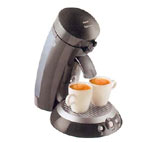
Senseo - Pod Machine

The PR machinery is running full tilt! It’s single-cup coffee machines—or, pod machines—everywhere you look… Phillips’ Senseo, Melitta One, Black & Decker Home Cafe, and the Keurig Brewer, to name those most buzzed about at the moment.

The Senseo reigns at the top of the buzzheap by a large margin, and you can easily find reviews of all stripes, from the usual tech “news” flaks, to geeks with laser-guided temperature probes... even fellow coffee blogger Randy Glass gets in on the game with his own hands-on review.Given the mass-marketed hype, and being a skeptic, I was fully prepared to dislike the Senseo. A lot.
Turns out, I don’t dislike it all that much. But keep reading.

The Senseo is a smartly-designed and smart-looking home coffee machine. It’s fabulously simple to use, and it appears to be built to stand up to frequent use [the same can not be said of some of its competitors].I have lingering concerns about its brew temperature. While Randy notes a brew temp of a respectable 190 degrees F. the folks at GadgetMadness record brew temps of a mere 138 to 140 degrees F. which is nowhere near acceptable. I have no particular reason to doubt either report, so I’m left to wonder if there might be a really high temperature variance from machine to machine… that would be a serious problem.

Temperature issues aside, it’s not the machine I have a problem with at all. It’s the quality of the coffee—and the source of that coffee—that leaves a bitter taste.
Currently, the only coffee pods for the Senseo available in the U.S. are those made by Douwe Egberts [whom you may know better as Sarah Lee] which developed the machine with Phillips. Sarah Lee is one of the Big Four, and together with Kraft, Nestle and Proctor & Gamble, they buy and sell half the coffee in the world.

These organizations are not known for the caliber of their coffee, but instead for their volume, and, more unfortunately, for their collective efforts to reap the benefits of historically low coffee prices, further contributing to the continuing coffee crisis.
So far as I can tell, there are no Fair Trade coffee pods for the Senseo. No organics. No shade-grown coffees, either. If you’re considering the Senseo, and you also want to consider sustainability, you’re in a bit of a bind. You might try to make your own coffee pods, or buy a reusable coffee pod adapter.

If these devices take hold, there will certainly be a number of independent roasters who will produce pods for them… and it’s just as certain that some of those roasters will offer coffee that’s more palatable all ‘round.
Meanwhile, if you want to brew a single cup at a time, try some fresh beans, a grinder, and a Melitta filter cone.